If Tarot’s Hierophant is supposed to represent divine wisdom and sacred tradition, why does he act like a corporate HR manager demanding you fill out paperwork in triplicate?
Anyone who has ever pulled the Hierophant card in a reading knows it can feel a bit… heavy. Traditionally, this card represents institutions, organized religion, dogma, and the “status quo.” But in the modern world, the idea of a grand, unquestionable authority figure feels less like spiritual enlightenment and more like a frustrating visit to the DMV.
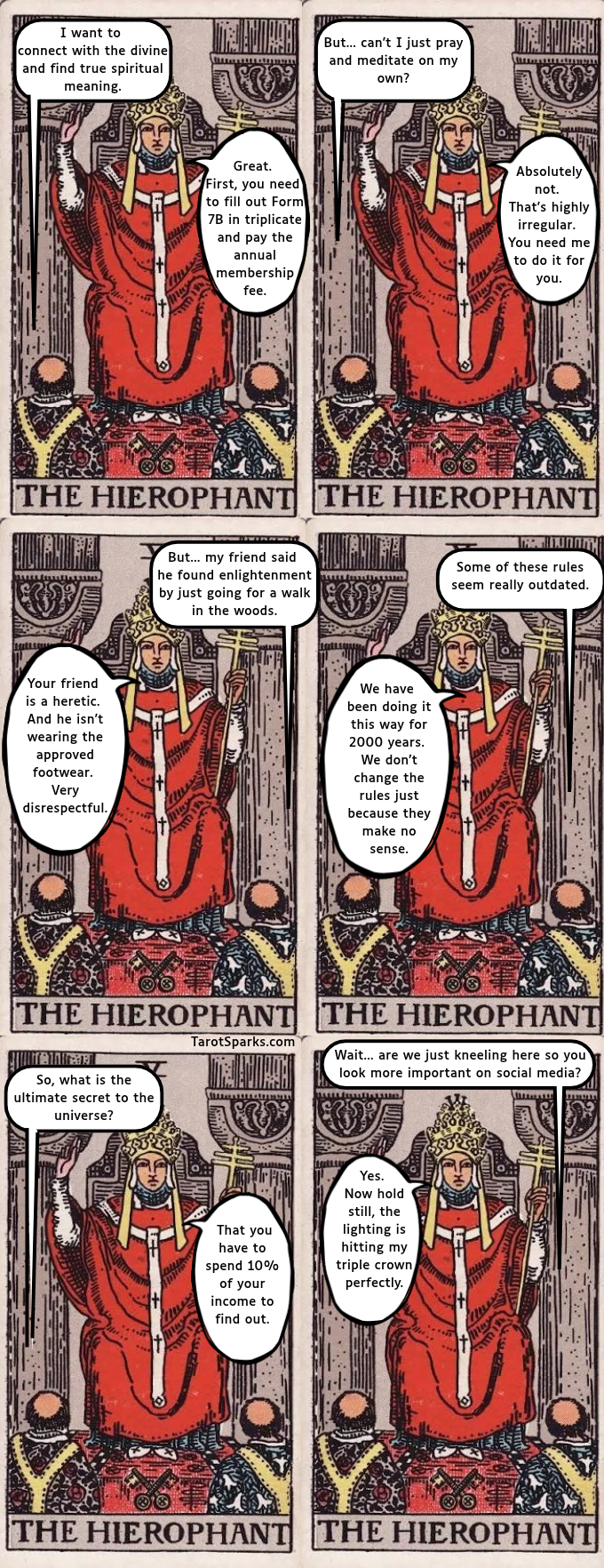
From Holy Man to Instagram Influencer: The Cynical Genius of the Hierophant Tarot Comic
I wanted to present the meaning of Hierophant through satirical comic. Make it less heavy, less serious. Such a dogmatic teacher deserves such attention. I took the classic Rider-Waite-Smith Hierophant card and paired it with dialogue that shatters his divine mystique. Yes, I repeat the same image again and again – the static image of the Pope-like figure and his two kneeling acolytes – across six panels, using speech bubbles to transform a sacred scene into a hilarious (I hope so) critique of modern bureaucracy.
Through a masterclass in deadpan humor, the comic strips away the Hierophant’s mystical facade to reveal the mundane reality of institutional gatekeeping. It translates ancient spiritual concepts into the annoying, everyday realities of corporate red tape, subscription fees, and social media vanity.
Let’s have a look at exactly how this comic uses modern cynicism to perfectly represent the ancient archetype of the Hierophant:
1. The Core Theme: Institutional Authority & Dogma
The Hierophant is traditionally the card of organized religion, tradition, education, and the status quo. He represents the “establishment.” The comic perfectly captures this by turning the Hierophant from a spiritual guide into a bureaucrat and gatekeeper. He isn’t offering enlightenment; he’s offering a subscription service and red tape.
2. The Visuals: The Pope as a Middle Manager
The comic uses the classic Rider-Waite imagery (the Pope figure on a throne, the triple crown, the two kneeling monks).
The Kneeling Monks (Acolytes): They represent the seekers, the everyday people looking for meaning. By making them ask innocent, logical questions, the comic highlights how powerless the individual is against the institution.
The Throne & Crown: These symbols of divine authority are mocked in the final panel when the Hierophant reveals he just wants a good angle for his “social media.” It reduces his grand, divine authority to modern vanity.
3. The Dialogue: Translating Spirituality into Bureaucracy
Each panel attacks a different aspect of the Hierophant’s traditional meaning:
Panel 1 (Form 7B in triplicate):
Represents Rules and Rituals. Organized religion often requires specific rituals to access the divine. The comic turns this into meaningless corporate paperwork.
Panel 2 (You need me to do it for you):
Represents Gatekeeping. The Hierophant is the intermediary between God and man. The comic mocks this by making him an arrogant control freak who doesn’t trust you to pray on your own.
Panel 3 (Your friend is a heretic):
Represents Orthodoxy vs. Personal Spirituality. Finding enlightenment in nature (the woods) threatens the institution. The joke about the “approved footwear” highlights how institutions care more about superficial conformity than genuine spiritual growth.
Panel 4 (2000 years of tradition):
Represents Tradition and Stagnation. The Hierophant values the past over progress. This is a direct shot at how institutions often defend outdated rules simply because “that’s how we’ve always done it.”
Panel 5 (10% of your income):
Represents Tithing and Corruption. The Hierophant is often associated with the wealth of the church. The joke exposes the transactional nature of some organized religions. You have to pay to play.
4. The Punchline (Panel 6): The Demystification
The genius of the final panel is how it destroys the Hierophant’s mystique. Suddenly, the acolyte realizes they are just kneeling to make the Hierophant look good for a selfie.
It reveals that the “grand authority” of the Hierophant isn’t divine at all. It’s just a performance. The entire structure of organized religion is reduced to a modern influencer trying to get good lighting for his triple crown.
✧ ✦ ✧
This comic reminds us that Tarot archetypes don’t exist in a vacuum. Instead, they are mirrors reflecting our everyday lives. By turning the Hierophant from an untouchable spiritual authority into a pedantic middle manager obsessed with red tape and his own reflection, I believe I made a card that is often seen as rigid or intimidating suddenly hilarious and deeply relatable. It’s a perfect example of how poking fun at the “status quo” can be a profoundly spiritual act in itself. No? Yes? Please, do let me know.
That being said, I really hope that no one takes this comic to heart. Tarot is a deeply personal tool (it is for me and I believe “everyone” should learn it for personal growth) and organized religion and spiritual institutions provide immense comfort, community, and meaning to millions of people around the world.
This comic is purely a lighthearted, satirical parody aimed at the concept of bureaucracy, not a genuine attack on faith, religion, or anyone’s personal spiritual journey. If the cynicism of this comic happens to ruffle any feathers or offend anyone, I sincerely apologize in advance because it is absolutely all in good fun.